
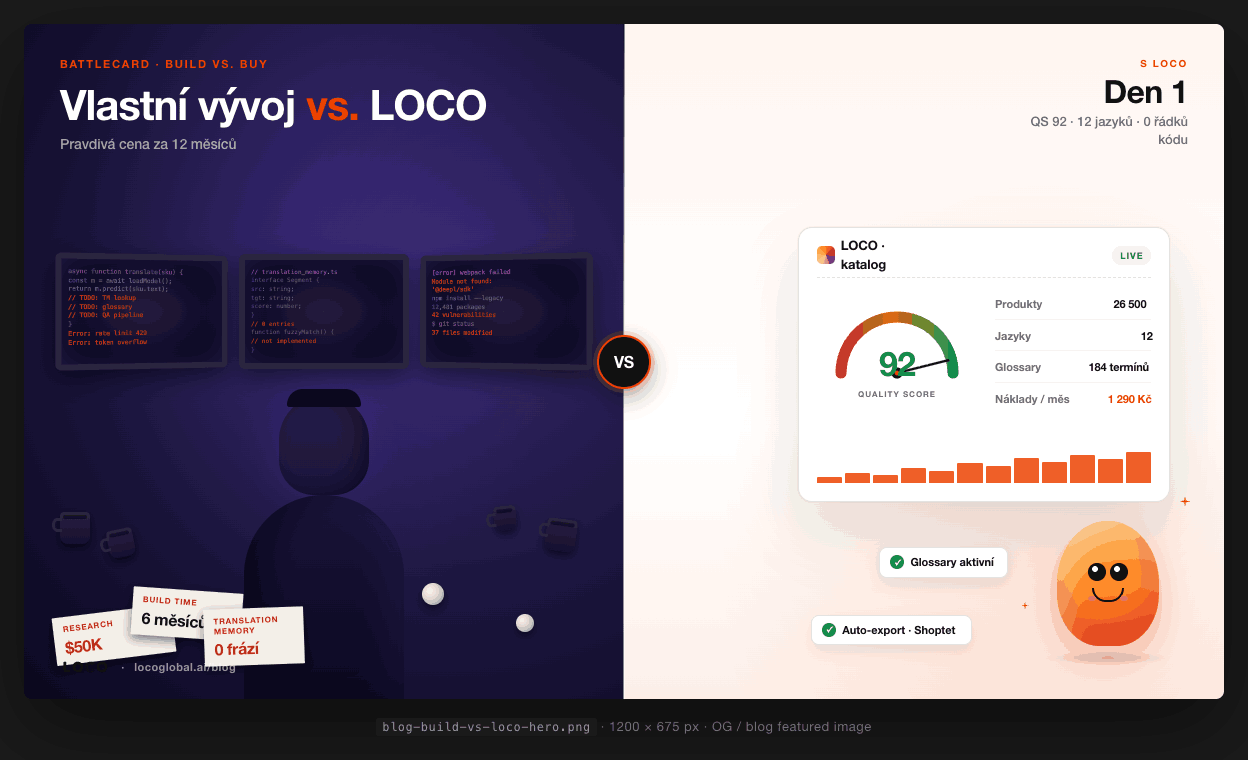
ChatGPT API costs around 0.20 USD per million tokens. Any junior can prototype with AI today. So why not build a custom translator for your e-shop?
This analysis pulls from 47 cases LOCO has seen at clients over the last two years. For those who won't read to the end: 41 of them ended up switching to LOCO. Because translation is 5 % of the work. The other 95 % is where in-house solutions usually get stuck.
What you actually need to make it work
1. Translation itself (5 % of the work)
This is the part a quick prototype handles over a weekend. Calling the ChatGPT API, falling back to DeepL or Gemini during outages, rate-limiting, cost monitoring. A junior developer ships it in a few evenings.
2. The quality layer (40 % of the work — where 90 % of e-shops fail)
Here it gets interesting:
- Quality scoring. Rating every product for grammar, clarity, terminology and brand tone.
- Duplicate and inconsistency detection. When "hardshell jacket" gets translated as "hardshellová bunda" in one place and "tvrdá bunda" in another.
- Brand-tone enforcement. Your tone of voice across multiple languages.
- Translation memory. A translation memory worth millions of crowns. LOCO has been building it for four years. You start from zero.
- A/B testing of prompts. The same product translated three different ways has very different selling power.
3. The operations layer (the remaining 55 %)
And this is where in-house bleeds the most:
- Sync with the e-shop platform (Shopify, Shoptet, WooCommerce, Magento, BigCommerce, PrestaShop, Upgates and others).
- Tracking new products. When you add a product, does it translate automatically?
- Re-translating when the source changes. When you edit a description, does it propagate to the translations? Does the whole description change? Do you have to re-check it?
- Export (XML feed, custom API hookup, bulk updates).
- Change log. Who approved which translation, when and why.
- Resolving conflicts between languages. When teams edit multiple languages at once.
The point: a quick prototype handles point 1. Points 2 and 3 are 95 % of the work. And that's the difference between building it and buying it.
Realistic 12-month cost calculation
In-house build — what you actually pay
Senior developer (3 to 6 months of building + 100 hours per month of maintenance) → €24,000 to €48,000
AI API costs (10,000 products, 8 languages) → €2,400 to €7,200 per year
Hosting, database, monitoring → €1,200 to €3,200 per year
Hidden cost: missing quality layer → lost conversion of 5 to 15 % in foreign markets
Hidden cost: missing consistency → 1 to 3 % of the catalog = broken products monthly
Total monthly: roughly €3,000 to €8,000
LOCO — what you actually pay
Medium plan (up to 2,000 products) → €52 per month
Large plan (up to 5,000 products) → €120 per month
Onboarding (one-off) → €200 to €400
Total monthly: roughly €60 to €200
Return: 30 to 100× cheaper. Immediate start. Quality layer already built in. Current pricing.
When in-house really pays off
Let's be fair. There are cases where LOCO recommends building:
✅ Build is recommended if:
- You have 100,000+ products (per-unit savings outweigh development).
- Localization is part of your core product (you are a translation tool).
- You have a specialized design tool for localization as part of your product.
- Your dev team has 20+ people plus dedicated QA.
- You already have your own translation memory (5+ years of data).
❌ Build is not recommended if:
- You have fewer than 50,000 products.
- The e-shop is your main product, localization is an add-on.
- The CTO or founder is doing the development.
- You don't have a dedicated localization-quality specialist.
- You want to be live in 3 months (a build takes at least 6).
- You want support for 5+ languages (translation-memory complexity explodes).
What LOCO solves that in-house can't
1. Translation memory with 4 years of compounding
Over four years LOCO has built a translation memory of 12 million phrases in an e-commerce context. Your in-house solution starts from zero.
- After a year you have roughly 50,000 phrases.
- After 4 years, 2 million.
- LOCO is 3 years ahead of you and has 20× the quality.
2. Brand-tone consistency
AI generates roughly 3 different variants for "hardshell jacket" in a single catalog. LOCO has a brand-tone agent that guarantees consistency. An in-house solution can't do that without a training loop (around €2,000 and 3 months of work).
3. AI-search readiness
ChatGPT, Perplexity and Google AI Overviews are a new acquisition channel. LOCO optimizes translations for AI search: structured data, semantic cleanliness, brand context. In-house fails here because it isn't designed for AI's needs.
4. Twelve specialized AI agents
LOCO isn't one translator. It's a senior team of 12 agents, each with a role: meaning analysis, tone control, terminology, search engine optimization, final polish. Building the equivalent by hand? Months of work.
When to start, when to stop
If you're still planning in-house development
- Try LOCO with 50 products free. You'll see the difference between translation and localization.
- Run the cost calculation above for your case.
- Ask yourself: what's your core competence? Localization or selling?
If you already have an in-house solution and are considering LOCO
- LOCO takes over your existing translation memory for free (up to 1 million phrases).
- Migration typically takes 2 to 3 weeks.
- Clients often add LOCO as a control layer on top of their own translator (audit and improvement).
The takeaway
A custom translator isn't about whether you can build it. It's about whether it makes sense given your core product, opportunity cost, and the quality layer that defines localization success.
In 41 of 47 cases: buy.
In 6 of 47: build (but it was a strategic part of the core product).
What's next
Run the real cost of in-house development for your case. Or get your current translations rated. Free audit of 50 products, report within 24 hours.


